Author: Joel Salatin

All posts

All Related

Happy Thanksgiving, Merry Christmas, and Happy New Year--that's a lot of stuff going on kind of lumped together.  Which brings me to my thought this month:  it's all related. Perhaps the signature difference between Polyface and current mainline food thinking is integration versus segregation.  I could use numerous words to describe this basic concept, like parts versus wholes, but I think these two are as good as any. Conventional industrial food systems break things apart.   We see it on farms that grow only one or two things, without regard for the greater inter-relatedness of ecology, all the way up to packaged and processed food.  Modern processed foods don't use whole ingredients; they use pieces of things.  They strip out the germ of the wheat, for example. They refine things to the point that the food bears no resemblance to its natural state.  Then they put all these pieces together and call it food.  But these pieces came from widely divergent places, and the beautiful unprocessed original no longer exists. When Dad and I were brainstorming what to call this farm venture that would eventually become Polyface, Dad's assumption was that we'd call it Salatin Inc.--you know, like Ford Motor Company or Chrysler (named for Walter P. Chrysler, the founder). I was adamant that it NOT be our family name for two reasons.   First, I suggested there may be a day when a Salatin isn't at the helm.  Secondly, I wanted the name to recognize integrated thinking. I came up with the name "Interface Inc." to recognize the three great environments:  water, land, and forest.   For 20 years, during what I call our experimental homesteading days, we'd been planting trees, fencing out riparian zones, fencing out the forest to protect it from cows, and developing a landscape plan with these various zones in mind.  The State Corporation Commission rejected the name because, unbeknownst to us, Virginia already had an "Interface Inc."  It was a labor arbitration company to work out disagreements between labor and management. I was milking the cow when Dad told me the bad news, and I spontaneously blurted:  "If we can't be Interface, let's be Polyface--the farm of many faces."  Dad laughed, but we both liked the idea, and it stuck and was approved. The point here is that from the outset, all our thinking was about how to leverage the various assets of the diversified ecosystem and then harness the distinctives of the various animals.   As a result, we looked at symbiotic natural patterns and have done our best to duplicate them.  The Eggmobile follows the cows so the chickens can scratch through cow pies.  We use pigs to aerate compost.  Our small flock of sheep is like a glorified weed eater, cleaning up fence lines and around farm buildings to reduce mowing. The animals move through the pastures, paddock to paddock; they don't stay in the same place. Illustrative of "conventional-think", Virginia Tech veterinary professors who judged my son Daniel's 4-H talk titled "Symbiosis and Synergy in the Racken (Rabbit-Chicken) House" at the state contest nearly 30 years ago couldn't restrain their skepticism.  "Aren't you concerned about diseases with two species that close to each other?" I was never so proud.  He was about 15 and, without batting an eye, looked those professors in the eye and replied:  "We've learned that most pathogens don't cross-speciate."   Folks, I had not prepped him for that question.  When he responded like that, those three professors slapped their legs and laughed at the audacious notion.  They had no further comments and immediately tried to recruit him to enroll at Virginia Tech and major in Veterinary Science. Instead, he stayed with me on the farm and scaled up these simple integrated relationships to the thousands of animals we have now--with virtually no vet bills.  Meanwhile, conventional experts wring their hands over bird flu, screw worm, African swine fever, blackleg, and a host of maladies that attack places where an integrated approach toward biology is severely lacking. Pediatrician Dr. Sharon Goldfield, director of population health for the Murdoch Children's Research Institute, wrote a fascinating op-ed in the Wall Street Journal last week titled "Baby Food and Youth Obesity."  She slammed "packaged baby and toddler foods" because they fail even rudimentary nutrition standards. Their surveys indicated that "80 percent of children are eating packaged toddler foods, many of which are ultra-processed, from an early age, with 43 percent of them eating these foods at least five days a week." Kids are eating out of boxes and slurping from concoctions created by a segregated mentality from field to stomach.  This segregated thinking even permeates parental decision making, divorcing overall health from food and assuming whatever happens, pharmaceuticals can fix it. At Polyface, everything we do assumes that everything we do affects something else we do.  It's that simple.   Both land health and people health occur when we realize everything relates to everything.  You can't just eat well and not exercise.  You can't dismiss the value of sunlight on your skin; especially early morning sunlight.  Hydration.  Sleep.  Stress.  Forgiveness.  Gratitude.  It's all part of us. As we celebrate all these holiday times and imagine the relatedness of Thanksgiving with the Christmas story with the eagerness of a new year, imagine all the things going on in your life and how they work together.  Or how if you pull them apart, things fray. Be assured that here at Polyface we're trying to integrate ecology, people, and economy in an overall symbiotic whole to deliver you the best food at a reasonable price.   And we thank you for helping us build an integrated whole that respects earthworms all the way to our dinner plate and microbiome.  We're not feeding you earthworms, but be assured they play an ongoing role in every bite you enjoy from Polyface.  Thank you. Joel

Carbonaceous Diaper

Sneak Peek: Here at Polyface, we're not just prepping for winter quarters; we're also stockpiling carbon as the basis of our spring compost application.

Food Shortages

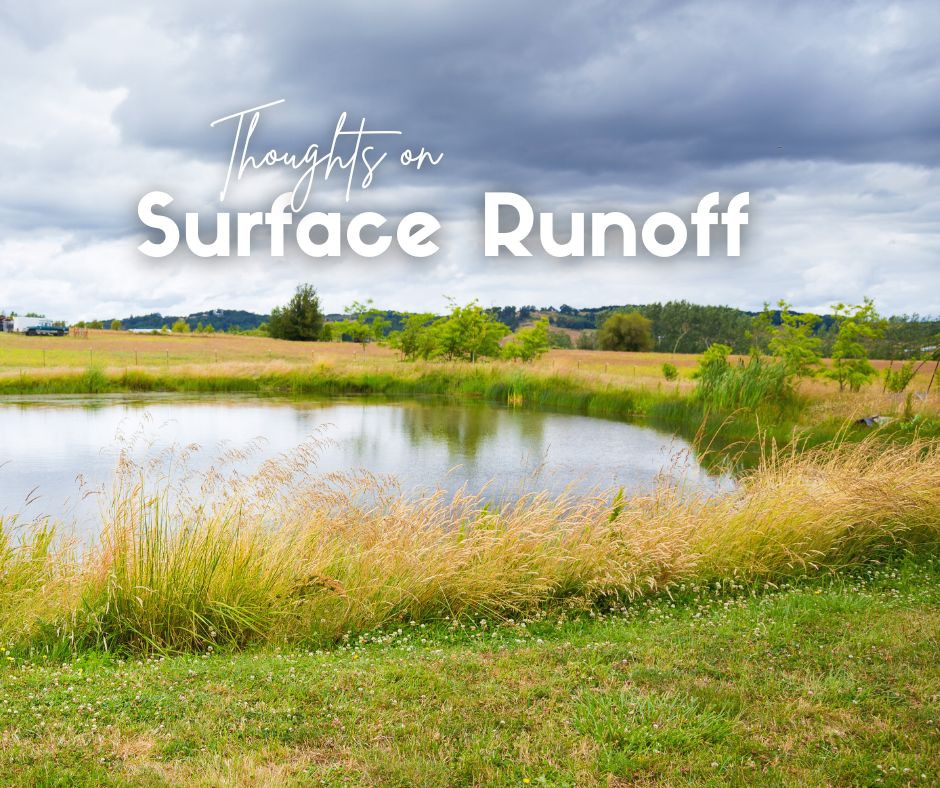
I'm in Oregon today speaking at the Azure Harvest Festival and a question from the audience during a Q&A stimulated a lot of discussion:  "What do you think about the possibility and preparation surrounding food shortages?" David Stelzer, founder of Azure Standard, answered that the issue is not food volume, it's food nutrition.   That was an interesting answer that has a lot of merit.  As a nation, we are overfed and undernourished.  This is the crux of the MAHA movement and the epidemic diseases we see in our country. At Polyface, we know the pastured meat and poultry we produce is far superior in essential phytochemicals and other nutrients due to the carotenes, exercise, and stress-free habitat we offer.  You can taste the difference, feel the difference in texture, and measure it empirically. Perhaps my most poignant affirmation was our cat test.   We purchased meat from the supermarket and offered our own for the four cats.  They wouldn't touch the conventional meat (ground beef). Even though two plates and four cats would be much easier to accommodate if they spread out, all four crowded around the plate with our meat, eating it all and licking it up, before later sniffing and gingerly eating the supermarket counterpart. Since cats don't understand TV ads or USDA propaganda, they know what's good and what's not.   We encourage anyone dismissive of food differences to ask their pets:  you can trust them far more than doctors and experts. Yes, I get the nutrient deficiency angle on the shortage question.  But I'd like to explore it a bit further.   Right now, the world throws away more human-edible food, as a percentage of production, than at any time in human history.  The planet is awash in food.   Some 40 percent gets thrown away because it has a slight blemish, exceeds the sell-by date, or is tainted in some way.  We have a fundamentally segregated food supply rather than an integrated one, and that creates a lot of unusable waste. The vulnerabilities of our food system, I think, are much more subtle.  When I was in Uruguay two years ago, speaking at a conference, one of the other presenters was from Germany and showed a soil map of the globe.  Not a single commercial agricultural region had a stable or positive soil trajectory.  Every single area on the planet is losing soil; some faster than others, but globally our soil depletion continues without any sign of abatement. This is not a good trajectory.   As much as the technocrats promise food without soil, that's not the way to bet.  Soil is the skin of the earth.  When it goes, famine results.   The main difference now compared to centuries ago is that we have the capacity to move food around.   Nobody starves due to a lack of food on the planet; they starve due to socio-political unrest and dysfunction. But what happens when massive areas can't grow anything anymore?  Even being able to move food around doesn't help when there isn't enough.   The soil trajectory does not look good.  But at Polyface, we're building soil.  Areas covered with shale (layered rocks) half a century ago now have a foot of soil on them.  That's not the 3-5 feet that 150 years of inappropriate tillage eroded, but it's a build-back start. In addition to soil loss, as a planet we're seeing hydrologic decreases.   The Oglala aquifer, which undergirds the irrigated agriculture in five states, has dropped more than 100 feet in the last half-century.  At its current rate, it will be unpumpable in about 50 more years.  Imagine if all those circular irrigation pivots in Nebraska and Kansas shut down.  What then? At Polyface, we keep building ponds to inventory surface runoff.  By definition, surface runoff occurs when rains come too fast at once or too much at one time for the soil to absorb it.  Holding that and using it strategically in a drought is a way to reduce flooding during rain events and grow grass when it gets dry.  This is one of the most landscape resilient techniques we can implement. Finally, major animal and plant diseases threaten the world's food systems like never before.   African swine fever, hoof and mouth disease in cattle, and bird flu in poultry appear to be getting worse and covering larger areas.  Why?  We believe it's because chemicals and factory farming compromise the immunological systems in both plants and animals.  Monocrops and chemical fertilizers wreak havoc on immune systems, opening the planet's food systems to new levels of fragility. In contrast, at Polyface, we believe happy animals and biodiversity offer the best antidote to immunological deficiency.  Stress from unsanitary conditions, mono-species density, or dietary deficiency (rations or fertilizer) invites disease.  Nature uses disease to cull the weak.  Predators pick off the stragglers.  This is the way biology works. But at Polyface, we keep these vulnerabilities at bay with compost fertilization, pasture rotations, and lots of species diversity, including pollinators and wildlife. Here's the point:  the basic long-term vulnerabilities in the planet's food systems could all be reversed with practices Polyface uses every day.  Looked at another way, the entire food shortage question could be answered if eaters and farmers implemented these ecological and immunological protocols, working together to rather than completely separated.  We don't need to fall into an abyss of starvation. If we all simply began eating food from farms that build soil, increase water, and stimulate immunity, we could deliver a hospitable, abundant planet to our children.   Reversing these trajectories wouldn't take much time or money.  It takes intentionally-minded folks who connect the chain of sustenance from their plate to the planet. Polyface patrons do that.  Thank you.  Let's heal the land together. Joel

Scents of Spring

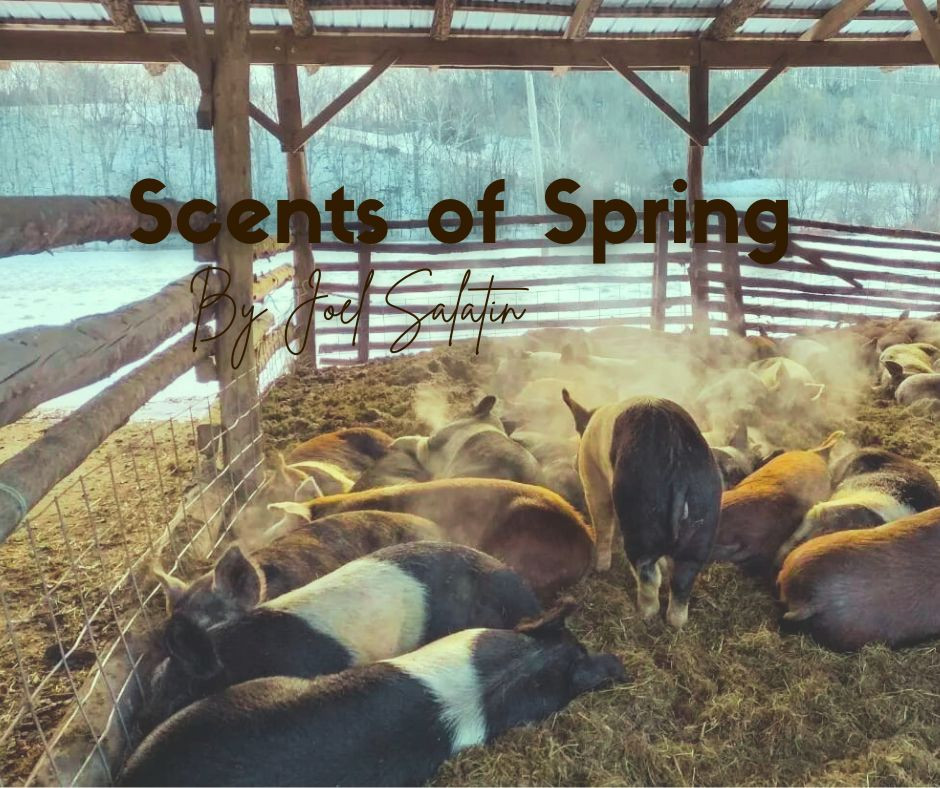
The farm aroma in spring is one of my most enjoyable smells of spring because I know it's caused by converting fermenting bedding into aerobic compost. Here's how it works...

Bird Flu

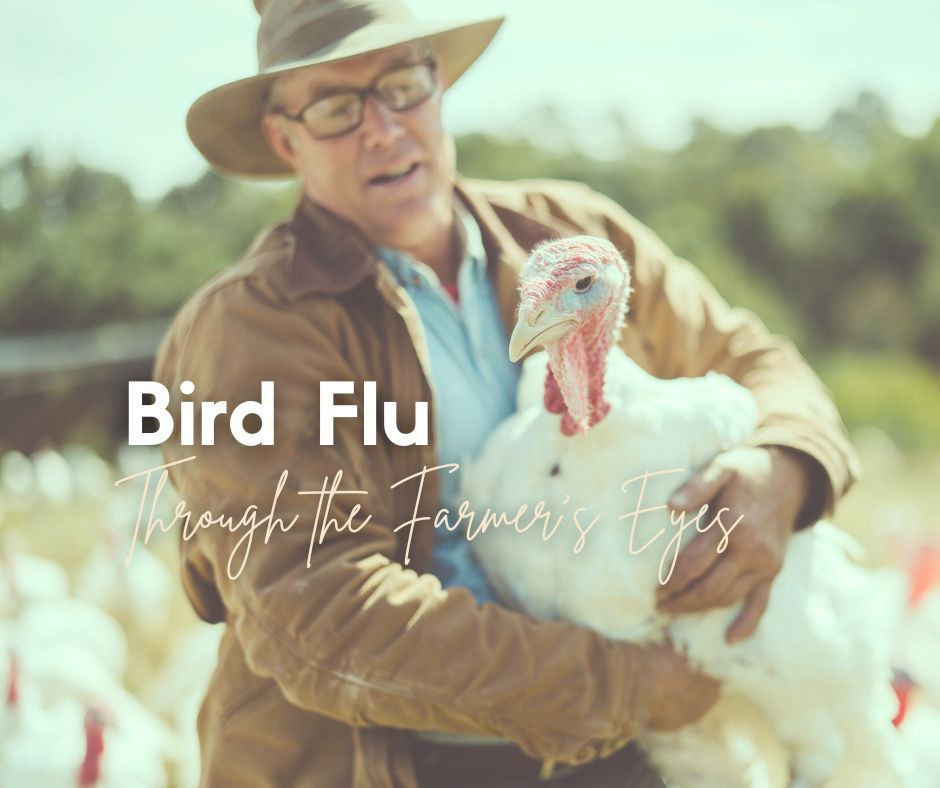
With many thousands of pastured chickens immersed in a wildlife-friendly ecology, we're watching this global issue. Here's our stance and plans for weathering this storm.

Grazing Plan

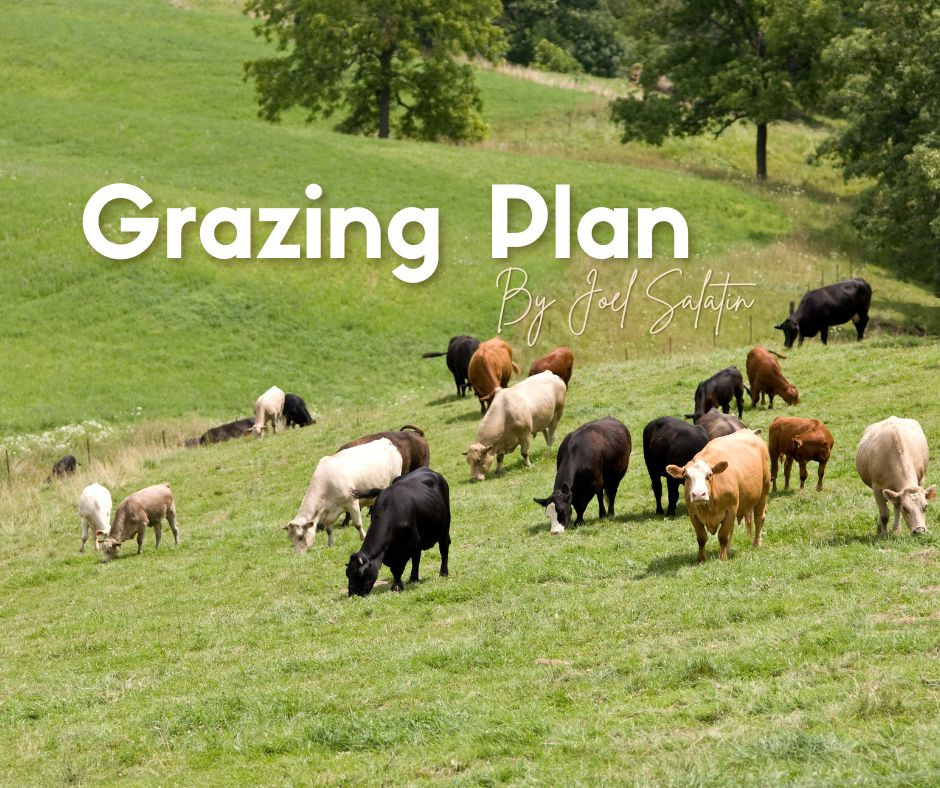
What's on your plate starts in late winter...with a calculator, lots of paper, figuring, and head scratching to get all the animals at the right place at the right time throughout the year.